Urbex — short for urban exploration — is far more than a niche pastime pursued by flashlight-wielding adventurers. It is a philosophy, a way of looking at a world that has moved on without us. An intimate confrontation with the mortality of things and, by reflection, with our own impermanence.
I have always been drawn to places that time has forgotten. Not the easy thrill of trespassing — that fades quickly — but something deeper: a desire to understand what remains when everything else is gone. What survives of a life, an institution, an industrial dream after the people have abandoned the field?
That is the question I carry with me every time I cross the threshold of an abandoned building with my camera.
The School That No Longer Rings
There is a moment, walking into an abandoned classroom, when the silence becomes deafening. Not the silence of an empty place — that is easy enough to bear — but the silence of a place that should have been noisy and no longer is.
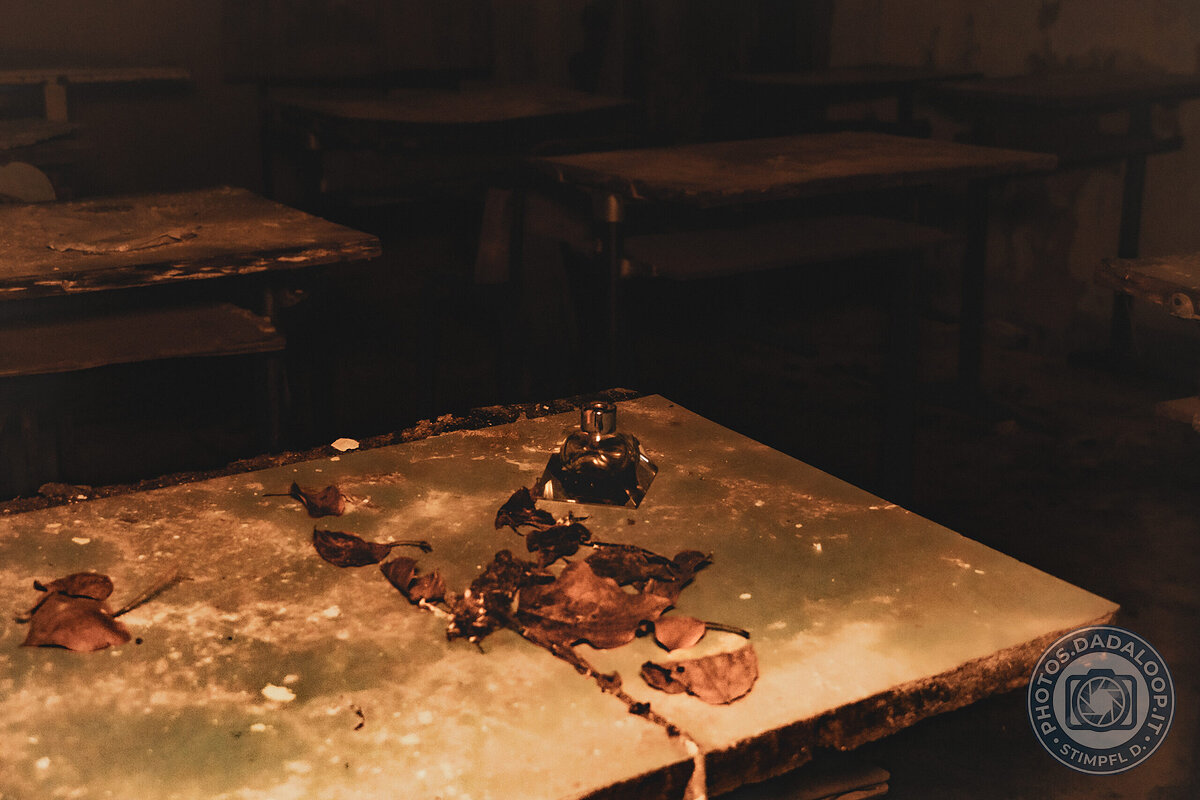
I took this photograph on an April morning. The light angled through broken windows and settled on that desk like a spotlight on an empty stage. The inkwell was still there, standing its post like a soldier no one had discharged. Dry leaves, drifted in from somewhere, had colonized the surfaces with nature’s quiet patience.
I sat on the edge of that desk, closed my eyes, and tried to feel them: the children who had once filled those chairs, the voices that had once filled that air. I imagined Latin lessons, heated geography debates, suppressed laughter travelling under the benches. Then I opened my eyes and the silence returned, heavier than before.
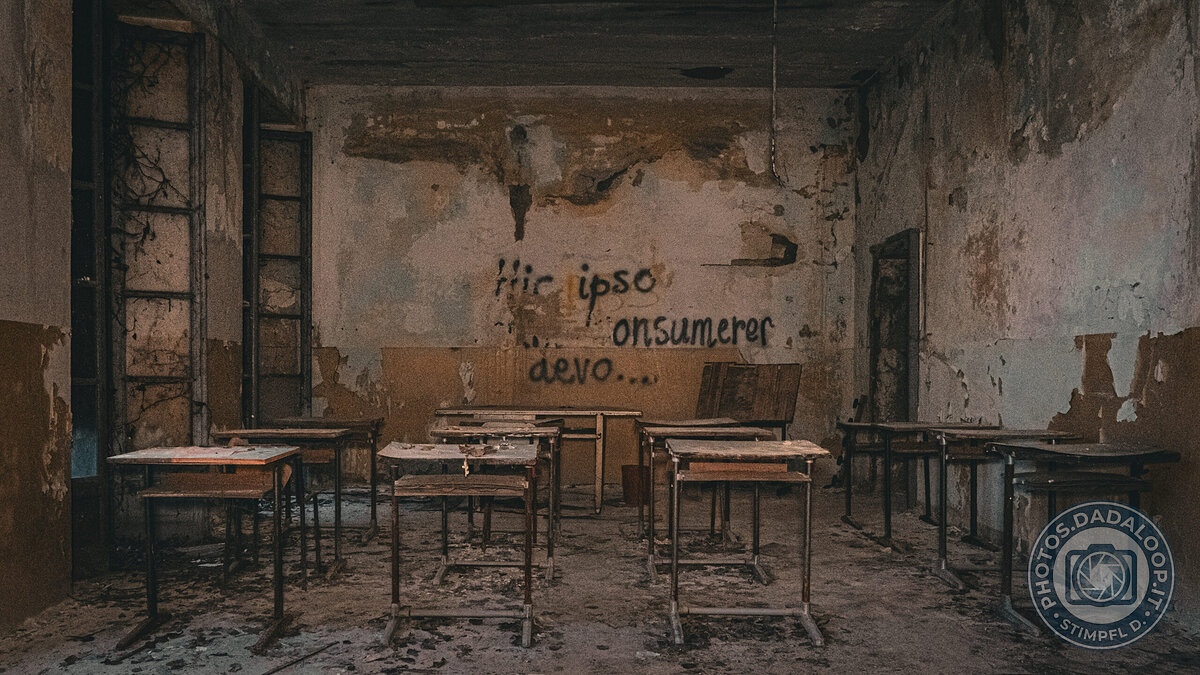
And then there are the graffiti. Someone — in a moment of inspiration, or boredom — left passages in Latin on the crumbling walls. Philosophical phrases, classical quotes, as if the place were invoking its original identity. As if the wall were resisting, in its own way, still teaching.
This is one of those moments that reminds me why I do what I do. No artificial set, no added lighting, no studio-built scenery
→ Explore the gallery: Abandoned School
The Corridors Where Breath Was Measured
If abandoned schools transmit melancholy, abandoned hospitals transmit something more visceral. Something that triggers primal instincts, that quickens the breath even of those who are normally unmoved by atmosphere.
It is not superstition — at least not for me. It is the recognition that these environments were the stage for extreme moments of the human condition: birth, illness, death. The weight of those experiences seems to settle into the structures themselves, into the chipped tiles, into the corridors that lead nowhere.
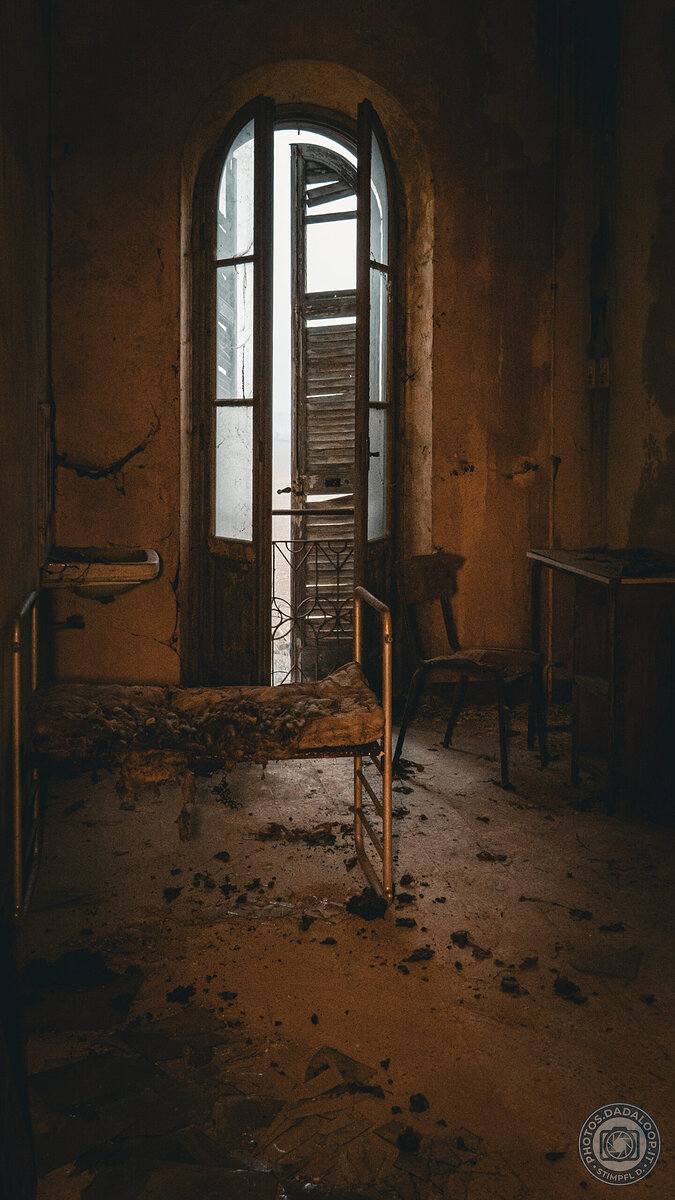
An abandoned hospital bed is an object that tells stories without opening its mouth. This one, with its rusted frame and dishevelled mattress, seemed suspended between two moments in time: the moment of its use and the moment of its abandonment. As if it were still waiting for someone.
I approached slowly, the way you do in churches or cemeteries, with an almost instinctive respect. I composed the frame trying to capture that suspended tension, that motionless waiting.
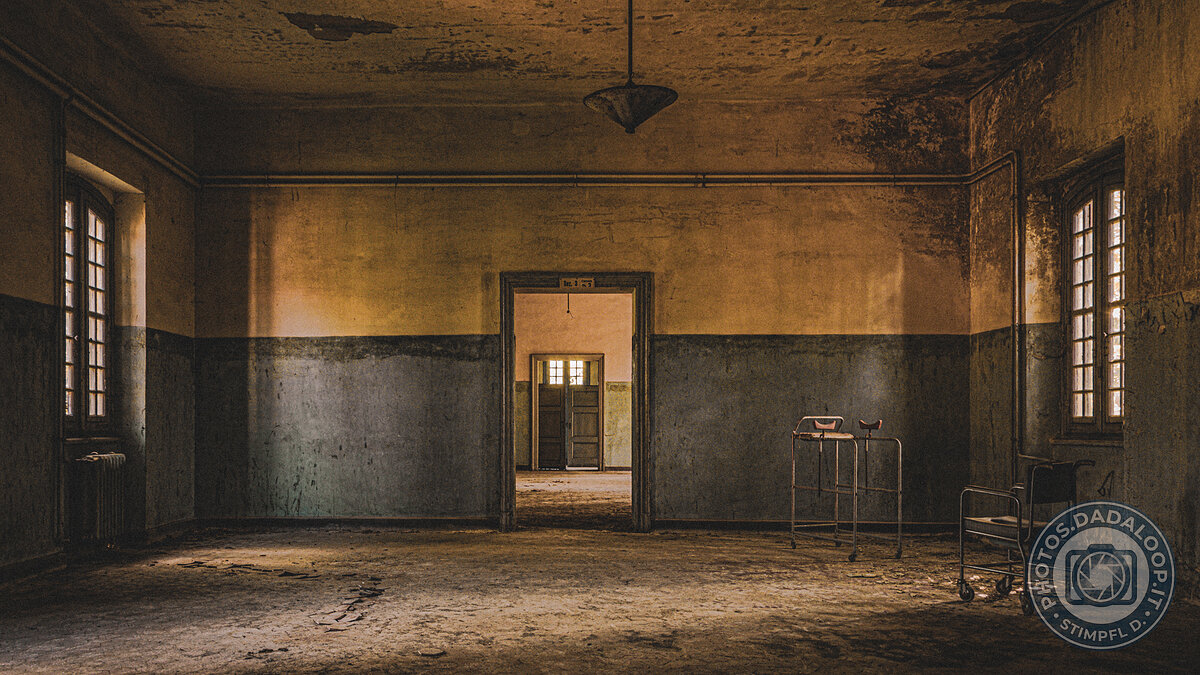
In another room, a medical trolley and walkers had been left exactly where someone put them — probably in a hurry, on a day that felt ordinary but turned out to be the last. Medical objects left behind carry a particular quality: they were made to serve human bodies, and that proximity to flesh and vulnerability
→ Explore the gallery: Abandoned Hospital
The Industry That Ground to a Halt
There is a type of abandonment that speaks not of individual lives but of entire eras. Decommissioned factories and industrial spaces do not tell personal stories — at least not immediately — but collective narratives: the end of an economic age, the twilight of a production model, the migration of whole communities toward an elsewhere that seemed better.
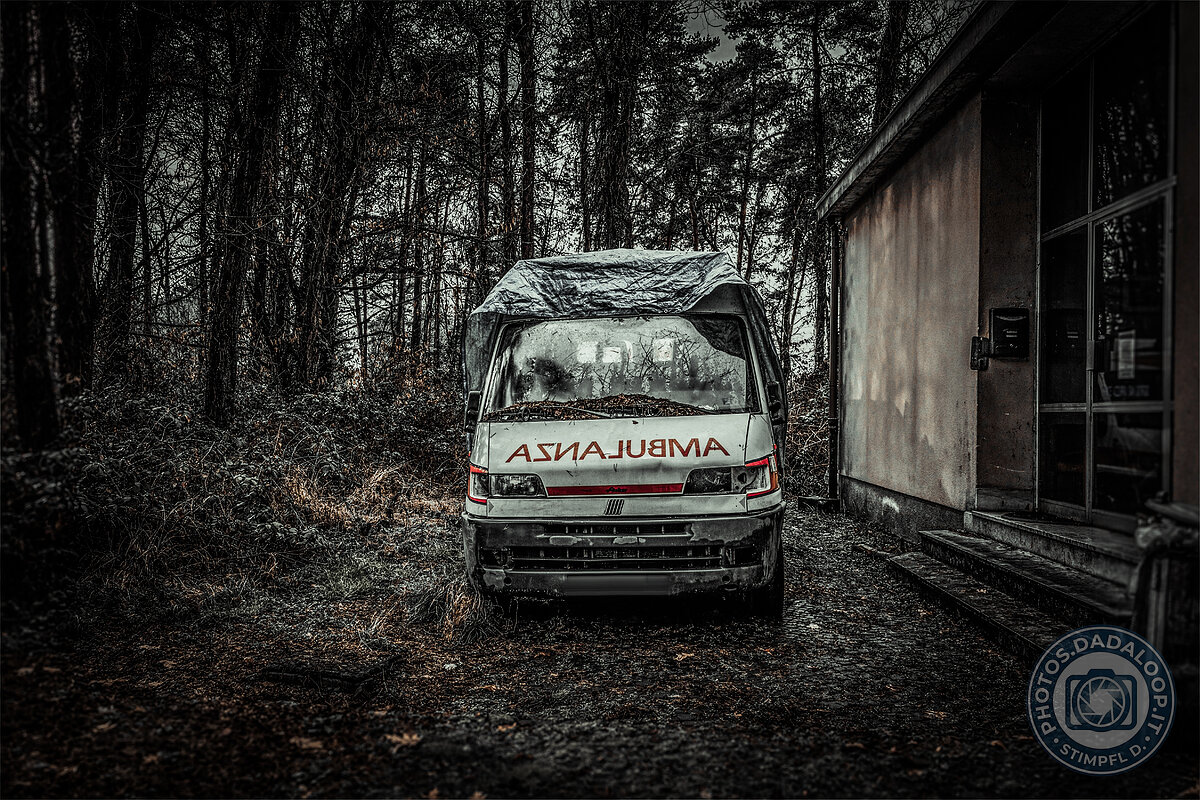
This ambulance, found among the overgrown vegetation, is one of the images that struck me most forcefully. There is something deeply paradoxical about a vehicle whose sole purpose was to save lives being abandoned to die slowly among the weeds. Nature, patient and relentless, has done its work — creating that tension between the built and the botanical that is one of the recurring themes in my photography.
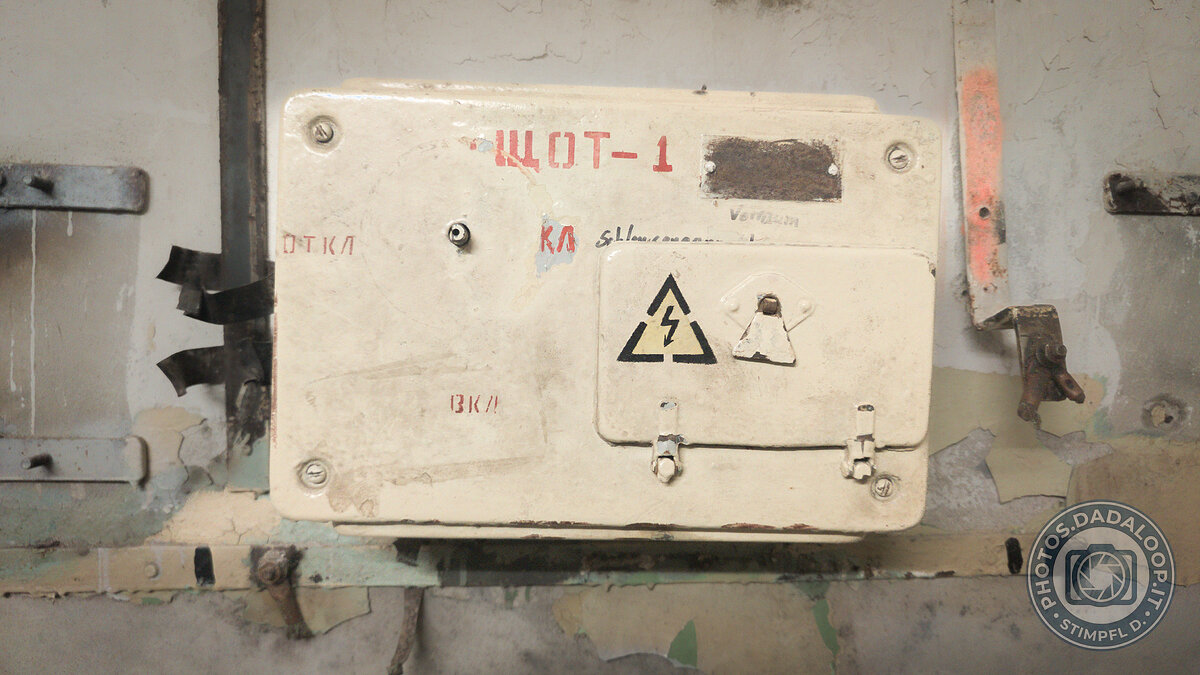
The warning signs on this long-defunct electrical panel are still there, still alert, still authoritative. “Danger to life,” says one of them. It is hard not to detect a certain morbid irony: the danger they point to no longer exists, yet the warning remains.
→ Explore the gallery: Abandoned Industry
Where Decay Ends and Art Begins
One of the most fascinating phenomena inside abandoned buildings is the art that proliferates there. Graffiti — too often dismissed as vandalism — takes on a completely different significance within these spaces. It becomes a dialogue between past and present, between decline and creativity, between death and life.
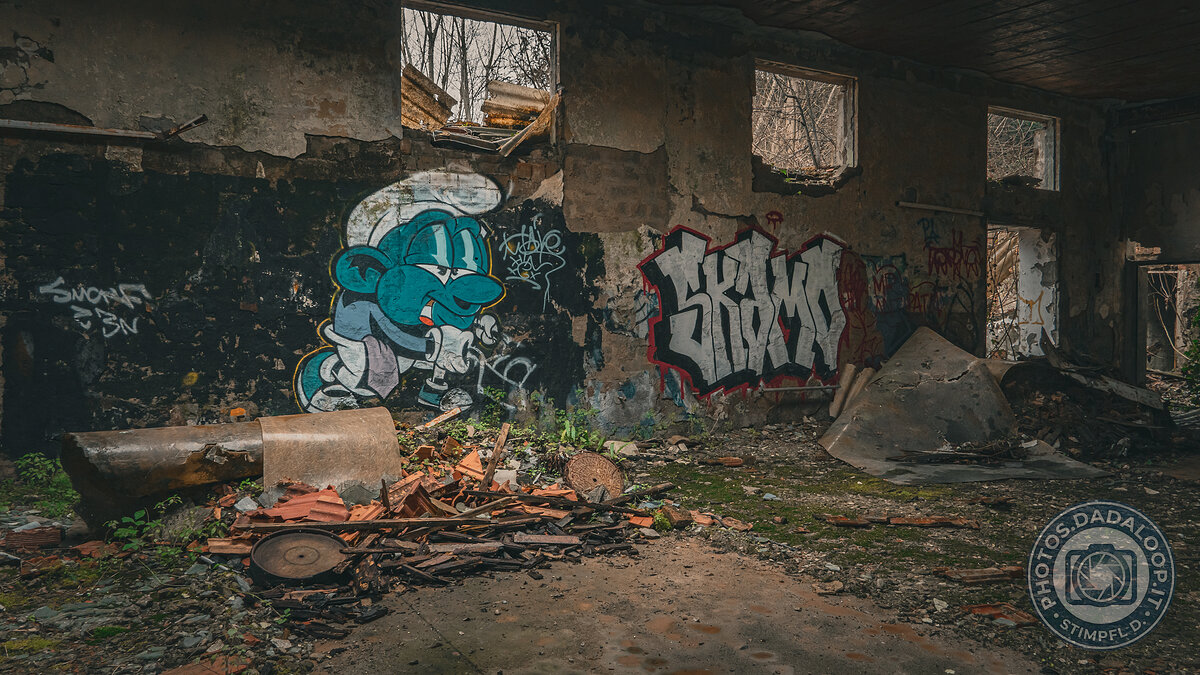
In this building, anonymous artists have transformed the peeling walls into an informal gallery. The vivid colours contrast with the grey of worn stone; the bizarre forms converse with the broken windows. There is something deeply poetic about this: beauty growing precisely where everything seemed to have ended.
I do not condone unsolicited painting on inhabited or protected private buildings. But in truly abandoned spaces, where nobody effectively claims ownership anymore, graffiti becomes almost necessary: a sign that the place is still alive, still visited,
→ Explore the gallery: Urbex Graffiti
When Nature Always Wins
There is one absolute certainty in urbex: in the end, nature always wins. You can build whatever you like — factories, hospitals, schools, palaces — but if you stop tending them, the green begins to reclaim its territory with a determination that knows no hurry but knows no hesitation either.
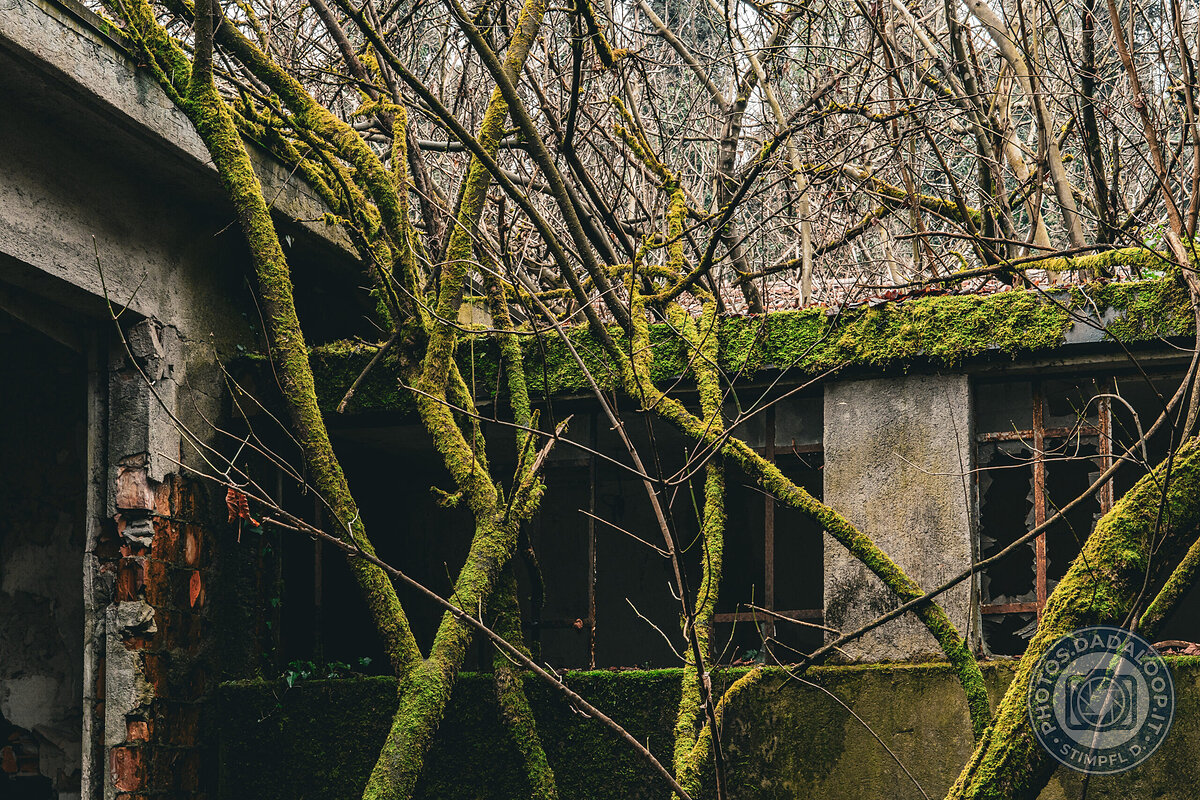
These moss-covered trees advancing through the building are among the most radical images I have ever made. There is no tragedy here — at least not from nature’s point of view — only the cycle of things completing itself. Humans built, humans left, nature returned.
It made me think of ancient classical ruins: Greek temples invaded by vegetation, Roman amphitheatres where flowers grow.
→ Explore the gallery: Nature Reclaims
The Brutalism That Refuses to Yield
Among all the architectures of abandonment, brutalism has a particular dignity. Raw concrete — the defining material of the twentieth century — does not decay with the grace of wood or stone, but it resists: it cracks, it crumbles, yet it remains. There is something almost stubbornly heroic about an abandoned brutalist building.
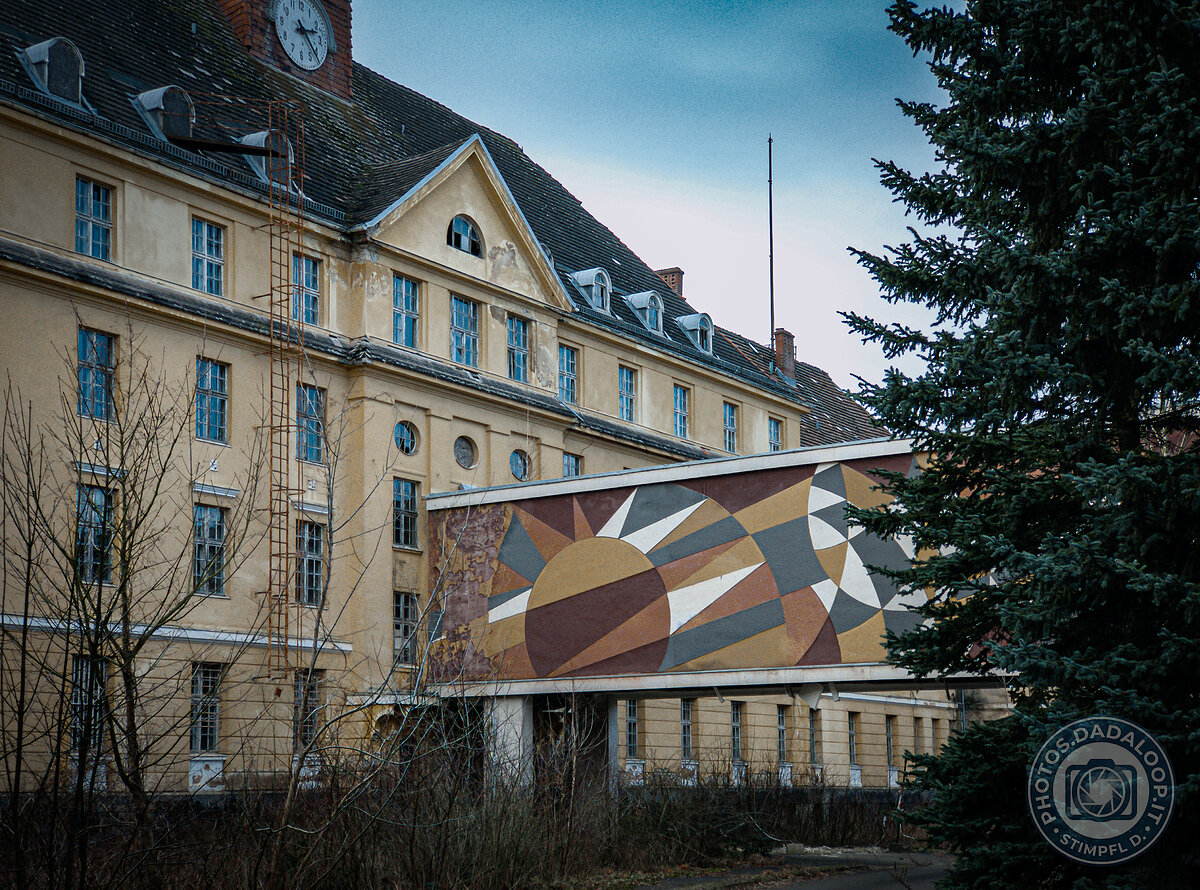
This building, with its frozen clock and the geometric mural that still insists on being there, is a perfect example of that dignity. The clock — which obviously no longer works — seems almost like a declaration of intent: “We were here. Our time was real.” The mural, with its faded but still legible colours,
→ Explore the gallery: Abandoned Brutalist Architecture
The Ethics of the Explorer
You cannot talk about urbex without addressing the ethical dimension. It is a practice that lives in a legal and moral grey area, and it is worth acknowledging that honestly.
My philosophy comes down to three words: look, photograph, leave. I take nothing — not even what would be easy to take. I do not touch, move, or alter anything. I enter only where it is physically possible to do so without forcing anything. And I respect private property: if someone is actively claiming a place, I do not go in.
These photographs are not an invitation to do the same. They are my way of documenting a reality that exists, that has dignity, that deserves to be seen before it disappears entirely — swallowed by oblivion or a demolition crew.
Because these places disappear. Quickly. A building abandoned today could be demolished tomorrow, renovated next month, razed to the ground within a year. Every time I shoot in somewhere like this, I know I am preserving something that would otherwise be lost forever.
What Remains
At the end of every outing, driving home with memory cards full and my mind still wandering the corridors of some forgotten place, the same question always comes back: what is left of us when we are gone?
These places try to answer. They say that things remain — the desks, the beds, the machinery — and that things speak, in their own way, of the people who used them. They say that nature remains, and that nature is far more patient than we are. They say that beauty remains, even where it seems impossible to find it.
And photographs remain. This is my small answer to the problem of disappearance: to fix a moment in time, even a moment of decay, and make something that lasts. Not out of nostalgia, but for memory. Not to stop time, but to bear witness that time passed.
Have you ever explored an abandoned place? Is there somewhere that time forgot which holds a special place for you? Share your story in the comments below.